The leadership to come does not predict the future: learn to inhabit it
Zygmunt Bauman said it long ago: “the only certainty is uncertainty.”
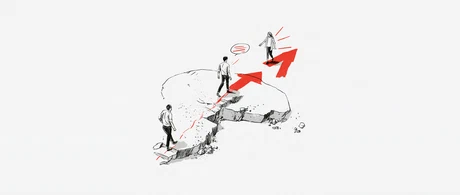
In a society where the only constant is change, and where the status quo transforms exponentially with every advance, we ask ourselves how much we can really control in order to ease that fear inherent to the human condition: the impact of the unknown.
And from there, the question is inevitable: how to lead yourself… and how to lead others.
Context is changeable. It always has been. But today’s speed of transformation gives it an even more frightening edge.
The point is not to avoid it, but to accept the current arrangement of the factors and, through the instinct of adaptability, draw the greatest possible benefit from it.
The ability to iterate, to redraw the roadmap based on data and real-time information, allows us to keep reconfiguring the reality we find ourselves in.
Innovation as a mantra for survival: daring to create within a framework where the threat of falling into obsolescence is already a promise.
And at the same time, to keep looking back to remember where we come from and why.
Bringing the professional and personal spheres into harmony appears today as an almost physiological human need, even though it is increasingly difficult to sustain that coherence between the authenticity of who we are and the force of what we do.
So, how do we keep moving forward from here?
Perhaps the question is not how to control the uncontrollable, but how to develop the inner and collective capacity to move within it without losing our center.
Leading in a constantly evolving world is not about holding on to certainties, but about holding presence.
- Presence to observe what changes without reacting automatically.
- Presence to discern what deserves to be preserved and what needs to be released.
- Presence to decide even when information is incomplete — because even today, with more information than ever, we still make many of our decisions blindly.
This demands a kind of leadership based less on control and more on awareness.
A leadership trained in three directions:
- Inward: self-awareness, emotional regulation, and clarity of purpose.
- Outward: genuine listening to the context, the teams, the market.
- And forward: a flexible, non-dogmatic vision, yet clear enough to guide action.
It is in this unstable balance that true leadership capacity is at stake today.
Perhaps innovating is not only about creating what is new, but about learning to live with the discomfort of not yet knowing what works while we keep moving forward.
Perhaps coherence is not a fixed state, but a daily practice of alignment between what we think, what we feel, and what we do.
And perhaps, ultimately, leading is not about avoiding uncertainty, but about learning to inhabit it without losing direction.
Because in a world that changes without asking permission, the one who predicts the future does not win.
The one who knows how to inhabit it does.
Did this resonate?
Let's talk30 minutes · No commitment